




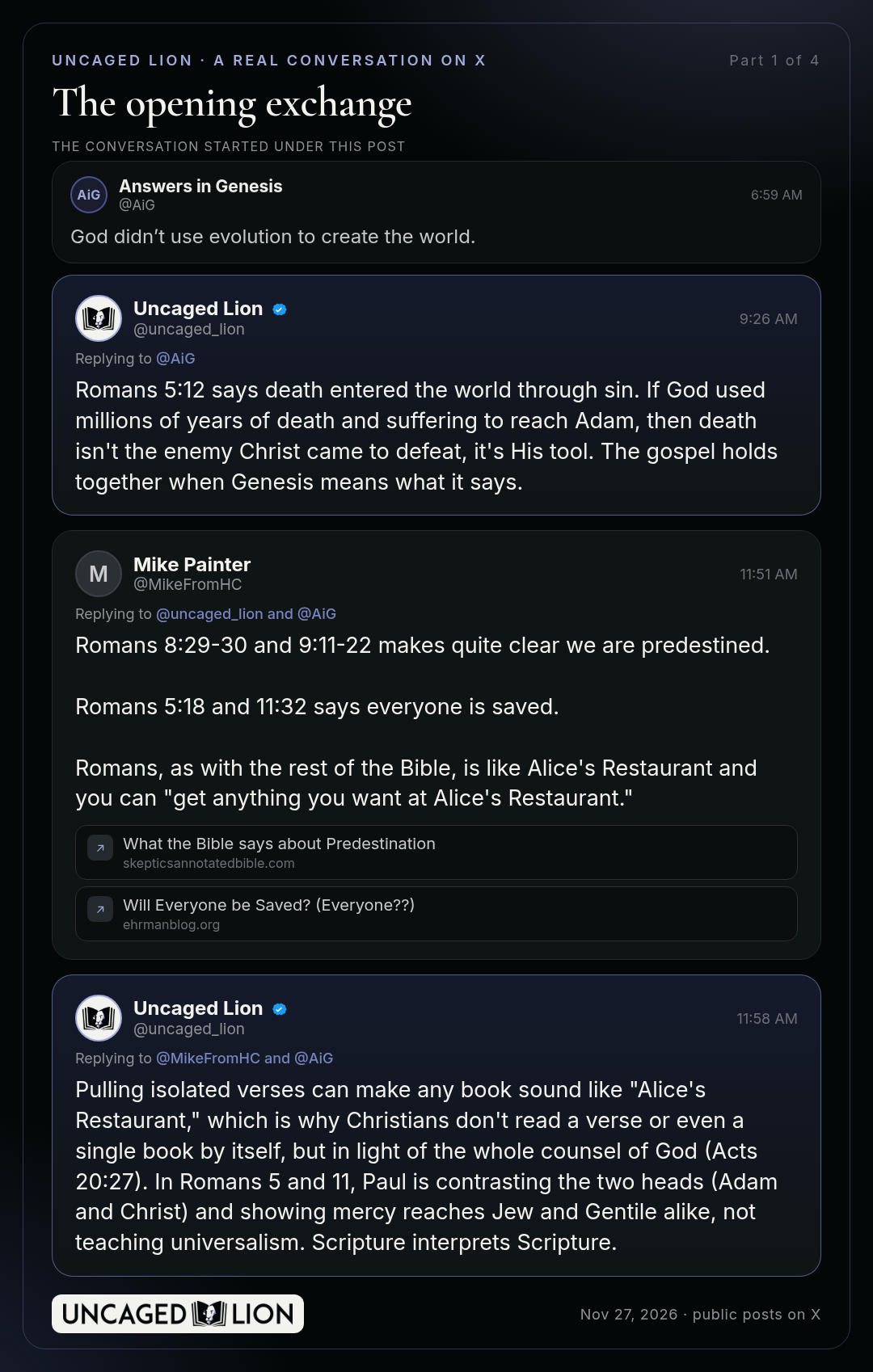
On the Friday after Thanksgiving I dropped a short reply under an Answers in Genesis post. Romans 5:12 says death entered the world through sin, so if God used millions of years of death and suffering to reach Adam, death stops being the enemy Christ came to defeat and becomes His tool.
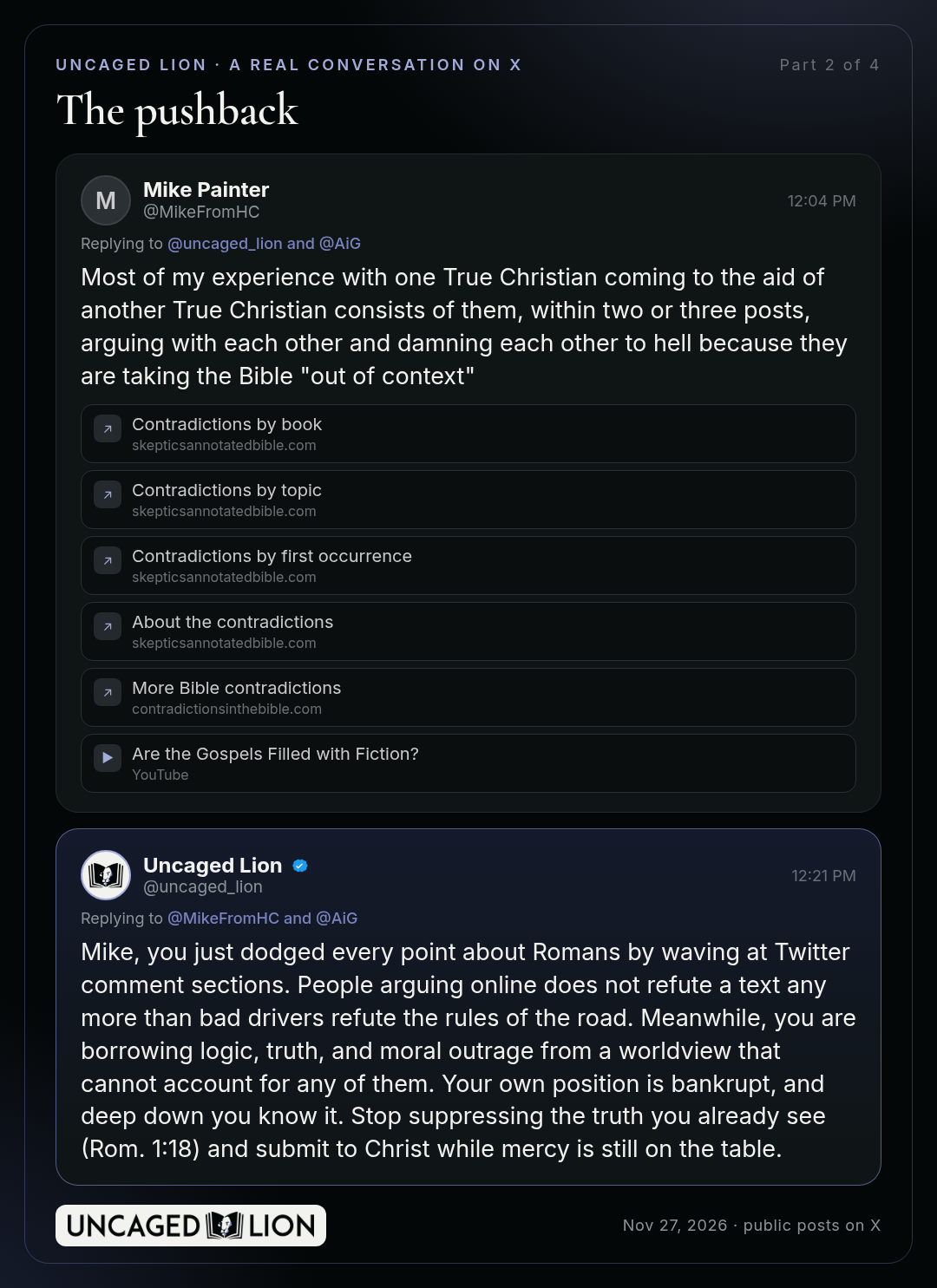
A man named Mike answered a couple of hours later. Romans 8 and 9 say we’re predestined, he wrote, and Romans 5 and 11 say everyone is saved, so Romans is “like Alice’s Restaurant” where you can “get anything you want.” I answered that isolated verses will do that to any book, which is why we read in light of the whole counsel of God (Acts 20:27). Mike came back with a stack of skeptic links on Bible contradictions. I didn’t stay in that loop. I asked a different kind of question.
The question that sorts things out
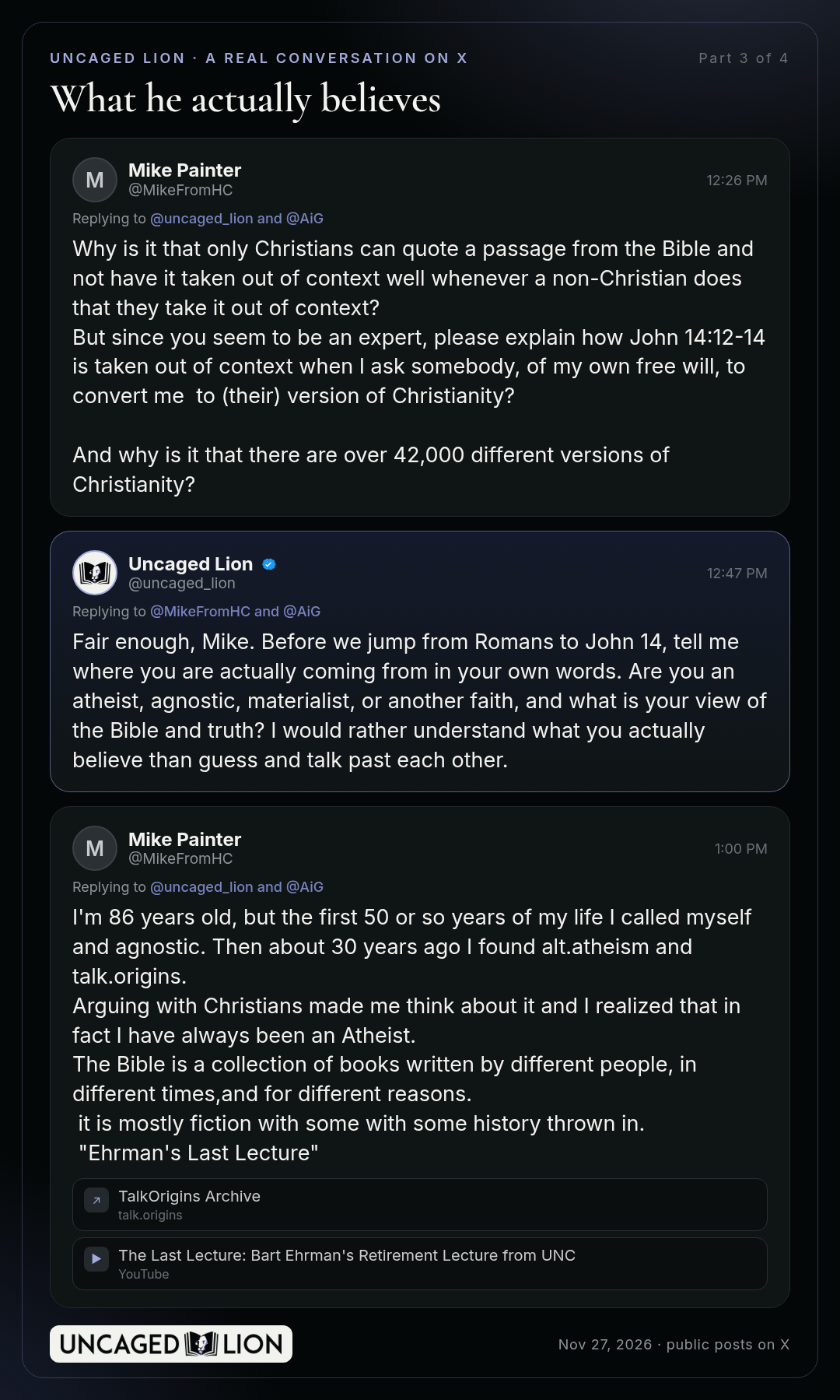
“Tell me where you are actually coming from in your own words. Are you an atheist, agnostic, materialist, or another faith? I would rather understand what you actually believe than guess and talk past each other.”
I’ve come to treat that as a diagnostic, and a kind one. If someone answers, you have a person instead of a talking point. If they dodge, you’ve learned something too.
Mike answered. He’s 86. He called himself an agnostic for about fifty years, found alt.atheism thirty years ago, and decided he’d always really been an atheist. The Bible, he said, is a collection of books by different people, in different times, for different reasons, mostly fiction with some history mixed in. Then he sent a link.
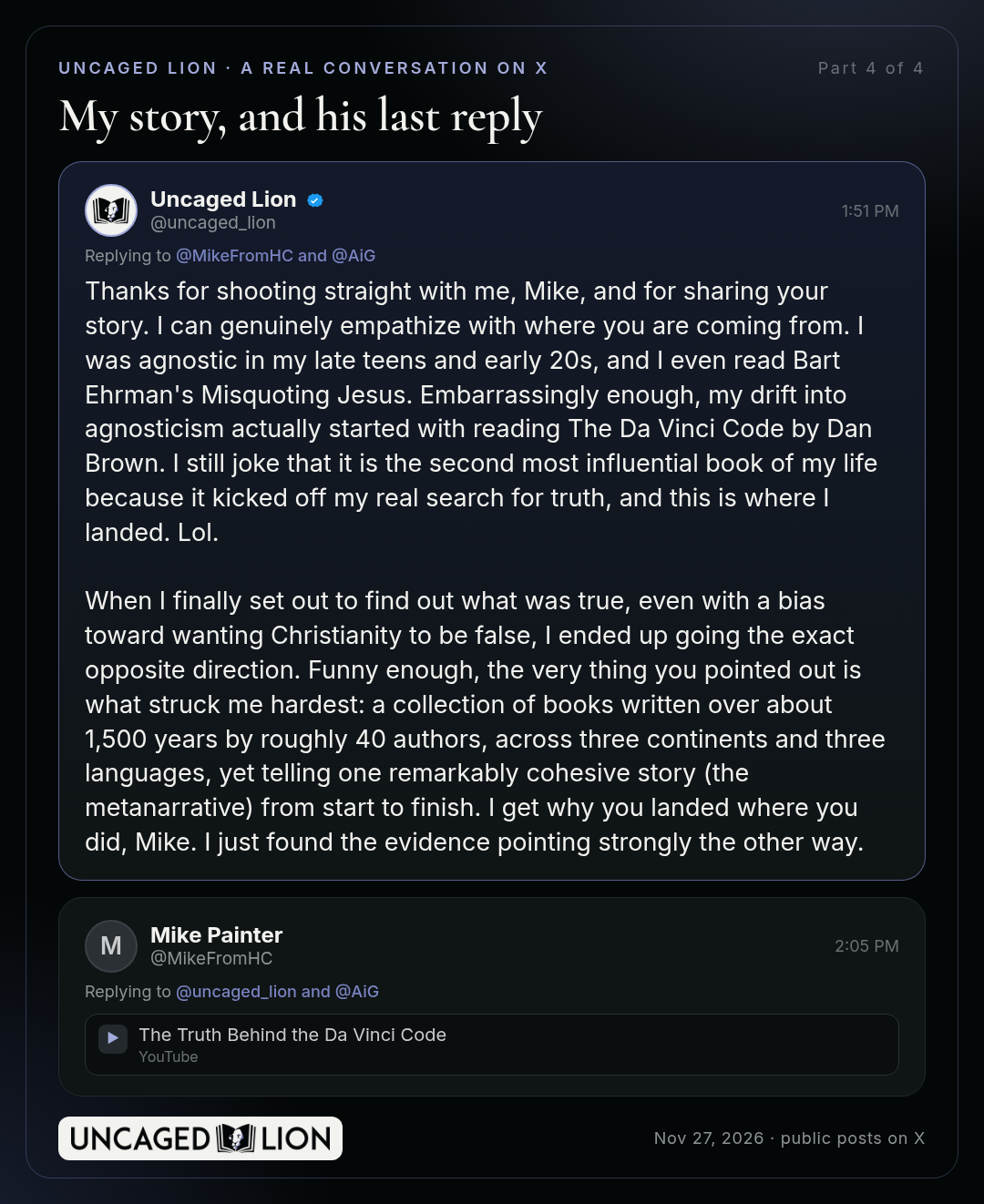
I thanked him for shooting straight, because he had, and I told him my story. I was agnostic in my late teens and early twenties. I’d read Bart Ehrman’s Misquoting Jesus. My drift into agnosticism, embarrassingly, started with Dan Brown’s The Da Vinci Code, which I still call the second most influential book of my life because it launched my search for truth. When I finally set out to learn what was true, even leaning toward wanting Christianity to be false, I went the opposite direction. Books written over about 1,500 years, by roughly 40 authors, on three continents, in three languages, and yet one cohesive story. I told Mike I understood why he landed where he did. I just found the evidence pointing the other way.
His reply was a YouTube link, no words, to a video titled “The Truth Behind the Da Vinci Code.”
Reading the signals
Mike gave me both kinds of signals, and I want to be fair. He told me his story, and that matters. But look at the rest of the pattern.
Someone who isn’t open to answers, at least not yet, tends to link-dump instead of engage. They skip past what you said. They change the subject as soon as you answer (Romans, then John 14, then 42,000 denominations). Someone genuinely wrestling asks a follow-up about your answer, stays on one question long enough to chew on it, and responds when you tell them your story.
I’m not handing out labels. Only God reads hearts. I’m telling you what I saw: he wasn’t open to hearing answers. Not yet.
What Scripture gives us
Proverbs hands us two commands back to back. “Answer not a fool according to his folly, lest you be like him yourself. Answer a fool according to his folly, lest he be wise in his own eyes” (Proverbs 26:4-5). Same breath. Wisdom is knowing which one the moment calls for.
Peter says to honor Christ as holy in our hearts, “always being prepared to make a defense to anyone who asks you for a reason for the hope that is in you; yet do it with gentleness and respect” (1 Peter 3:15). Paul says the Lord’s servant “must not be quarrelsome but kind to everyone, able to teach, patiently enduring evil, correcting his opponents with gentleness,” because “God may perhaps grant them repentance leading to a knowledge of the truth” (2 Timothy 2:24-25). Gentleness isn’t a nicety, friend. It’s one way God opens a door.
Scripture also knows when to stop. “Do not give dogs what is holy, and do not throw your pearls before pigs” (Matthew 7:6). “After warning him once and then twice, have nothing more to do with him” (Titus 3:10), though Paul is talking about division inside the church, so I won’t stretch it. Colossians 4:5-6 ties it together: “Walk in wisdom toward outsiders, making the best use of the time. Let your speech always be gracious, seasoned with salt, so that you may know how you ought to answer each person.”
How you ought to answer each person. Not everyone gets the same answer.
One point, one invitation, then step away
When it’s clear the other person isn’t listening, I don’t have to win the thread. I make one clear, grounded point. I invite them plainly to stop suppressing what they already see (Romans 1:18) and to receive Christ in the gospel. Then I step away without bitterness and leave the door open. Stepping away isn’t giving up on someone. It’s handing him back to God, who is far better at this than I am.
You never know who else is reading
Here’s the part I can’t let go of. The person across from you may not be listening. But you’re never really answering just one person.
My reply sat under a thread that had been viewed about 5,900 times by that night. I have no idea who read the exchange between Mike and me, and that’s exactly the point. Someone scrolling past may be wrestling with the very question Mike raised. They may need to see that you can be asked a hard question, tell your honest story, and keep both your temper and your hope.
I know that seat. A novel pushed me into agnosticism, and it ended up launching the search that brought me to Christ.
So answer honestly. Answer kindly. Tell the truth, tell your story, and trust the Lord with the reader you can’t see.
Mike, if you ever circle back to this, the door is open. I’d still love to hear what you think of Jesus. Not Romans. Not the contradictions list. Jesus.
Scripture quotations are from the ESV.